
China to Launch First Foreign Astronaut as Pakistani Pilots Train for Tiangong Mission
China will carry its first foreign astronaut to the Tiangong space station this autumn, selecting between two Pakistani pilots currently training in Beijing. The one-week mission relies on Chinese spacecraft, facilities, and training, marking a major milestone in space cooperation between Islamabad and Beijing.
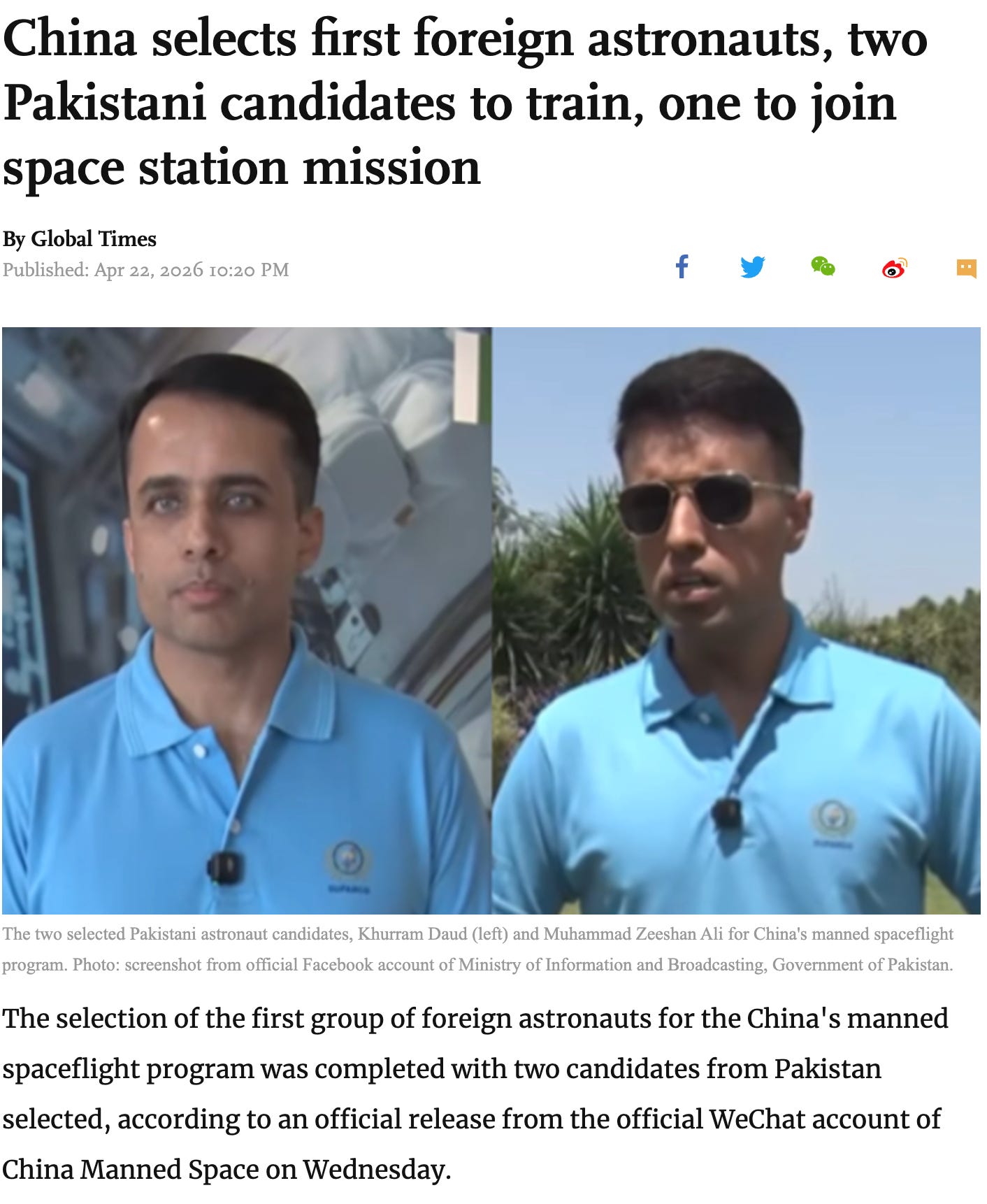
Two Pakistani pilots are undergoing intensive training in Beijing to become the first foreign astronaut on China's Tiangong space station. A final selection between Zeeshan Ali and Khurram Daud is scheduled for mid-to-late October.
Selected from a pool of roughly 20 finalists, both candidates are high-speed military pilots chosen for their capacity to endure heavy g-forces. Their training includes Mandarin language instruction, centrifuge drills, microgravity adaptation, and technical maintenance.
The selected pilot will launch directly from China this autumn for a one-week mission, returning alongside two Chinese crew members who arrived in orbit in May. Because Pakistan lacks independent crewed launch capabilities, the mission relies entirely on Chinese spacecraft, facilities, and instruction.
China's invitation marks the first time its space program will transport an international astronaut, reflecting expanding space cooperation between Beijing and Islamabad under the Belt and Road Initiative. Previous joint projects include satellite launches, a shared navigation system, and a planned Pakistani-built autonomous lunar rover for China's Chang'e 8 mission in 2028.
The upcoming Tiangong flight will carry four Pakistani biotechnology experiments aimed at addressing climate change and food insecurity. Designed in local universities and validated in SUPARCO laboratories, the payloads will undergo final technical sign-off by Chinese engineers before installation on the 77-ton space station.


